How Profitable Is a Laser Tag Business?
If you're researching whether a laser tag business is profitable, you've probably already explored startup costs, equipment investments, and arena expenses. Those numbers matter, but they only tell half the story.
The real question isn't how much a laser tag business costs to launch. It's how effectively that investment converts into consistent revenue and long-term returns.
Two laser tag businesses can have similar startup costs, yet one becomes highly profitable while the other struggles to break even. The difference rarely comes down to a single factor. It comes down to how well an operator converts their investment in commercial laser tag equipment, facility space, and customer demand into repeatable revenue streams.
It's also worth remembering that profitability isn't just revenue. A business generating $500,000 annually isn't necessarily a better investment than one generating $200,000 if it requires substantially more capital, staffing, and operating expenses to achieve those results. What matters is return on investment (ROI), how much profit the business produces relative to the money invested.
iCOMBAT has equipped operators across 80+ countries, from mobile laser tag startups to full tactical arenas, and the patterns around what drives (and kills) profitability are consistent. This guide covers those patterns, with real numbers.
The Short Answer: Yes Laser Tag Can Be Highly Profitable
A well-managed laser tag operation generates strong margins, especially when it combines:
- Strong player throughput during peak hours
- Birthday parties and private events (highest-margin revenue stream)
- Corporate and group bookings
- Repeat customers and membership programs
- Reliable equipment with minimal downtime
Unlike most businesses, laser tag doesn't require restocking inventory every time a customer plays. Once the arena and equipment are in place, the incremental cost of serving additional players is low, which is what creates the margin potential.
For example: if a facility charges $25 per game and hosts 20 players, that's $500 from a single session. At two sessions per hour during peak periods, revenue can exceed $1,000 per hour before food, memberships, or party bookings are counted.
Laser Tag Profit Margins by Business Model
Laser tag profit margins vary significantly by model. These ranges reflect real operator performance across iCOMBAT's global network:
Your content goes here. Edit or remove this text inline or in the module Content settings. You can also style every aspect of this content in the module Design settings and even apply custom CSS to this text in the module Advanced settings.
Business Model | Average Startup Cost | Annual Revenue Range | Profit Margin | ROI Timeline |
Mobile Laser Tag | $10,000-$75,000 | $30,000-$180,000 | 20-60% | 6-18 months |
Battle Quest Arena | $150,000-$500,000 | $200,000-$600,000 | 20-40% | 1-2 years |
Tactical Laser Tag Arena | $250,000-$950,000 | $450,000-$1.5M | 25-45% | 2-3 years |
Family Entertainment Center | $500,000-$2M+ | $500,000-$2M | 15-40% | 2-4 years |
Mobile operations tend to show the highest margins because overhead is low, no lease, no full-time staff, no utility bills on a fixed facility. Indoor arenas generate more gross revenue but carry more fixed costs that compress margins.
Understanding ROI in a Laser Tag Business
When evaluating any business opportunity, ROI is more meaningful than revenue alone.
Actual results depend on:
- Market demand and local competition
- Location and accessibility
- Pricing strategy
- Operating efficiency
- Marketing effectiveness
- Equipment reliability and uptime
Not all factors contribute equally.
The following consistently show the greatest impact on long-term ROI:
Profitability Factor | Impact on ROI |
Repeat customers and membership programs | Very High |
Birthday parties and group events | Very High |
Equipment reliability and uptime | Very High |
Software, game modes and player engagement | High |
Revenue per square foot | High |
Food, beverage and add-ons | Moderate to High |
Marketing and customer acquisition | Moderate |
How Much Does a Laser Tag Business Owner Make?
Owner income varies widely based on the business model, size, and how involved the owner is in day-to-day operations.
Based on operator data across iCOMBAT's network:
Business Model | Annual Owner Income (Average Range) |
Mobile Laser Tag (owner-operated) | $30,000-$90,000 |
Battle Quest Arena (2,500-4,000 sq ft) | $50,000-$130,000 |
Tactical Arena (5,000-9,000 sq ft) | $120,000-$450,000+ |
Large FEC with Laser Tag | $200,000-$500,000+ |
These figures assume an owner-operator model where the owner takes a salary or draws rather than leaving all profits in the business. Operators who reinvest profits into expansion, additional equipment, or marketing typically see compounding growth in years 3–5.
The Real Profit Driver: Revenue Per Customer
Many new operators focus on ticket sales. Experienced operators focus on customer value.
Consider the difference between these two customers at a tactical laser tag location:
Customer A - One-Time Visit
- Plays one game: $25
- Leaves immediately afterwards
TOTAL VALUE: $25
Customer B - Loyal Player
- Plays one game: $25
- Buys snacks: $10
- Returns 6x per year: $150
- Books a birthday party: $400
- Brings friends/family to each visit
LIFETIME VALUE: $600-$750+
Both customers walked through the same door. The difference in long-term value comes entirely from whether your business is designed to bring them back.
The most profitable laser tag businesses invest in:
- Membership programs and season passes
- Loyalty rewards and player rankings
- Event packages with high perceived value
- Seasonal promotions and competitive leagues
Revenue Per Square Foot: The Metric Most Operators Overlook
Occupancy costs, rent, utilities, maintenance, scale with your space, so revenue per square foot is a useful efficiency signal. But it measures efficiency, not profit, and the two don't always agree.
Your content goes here. Edit or remove this text inline or in the module Content settings. You can also style every aspect of this content in the module Design settings and even apply custom CSS to this text in the module Advanced settings.
Facility | Size | Annual Revenue | Revenue per Sq Ft | Verdict |
Arena A | 4,000 sq ft | $400,000 | $100/sq ft | More efficient |
Arena B | 8,000 sq ft | $600,000 | $75/sq ft | Higher revenue, lower efficiency |
Arena "A" looks more efficient, but that's not the whole story. Three questions decide which space actually wins:
- Does the extra space pay for itself? Arena B's added 4,000 sq ft earned $50/sq ft. If that beats the marginal cost of the space, added rent, utilities, maintenance, and build-out, the bigger arena adds profit even while appearing less efficient.
- Is there a better use of the capital or floor area? If that money, or those square feet, would earn more as a second location, an arcade, or food and beverage, the smaller footprint may win. If not, bigger isn't bad.
- Does the scale create a competitive edge? A larger, distinctive arena unlocks high-value bookings, small rooms can't take corporate events, tournaments, leagues, big parties, earns pricing power, and draws players from a wider radius, turning a commodity into a regional destination that's hard for competitors to follow.
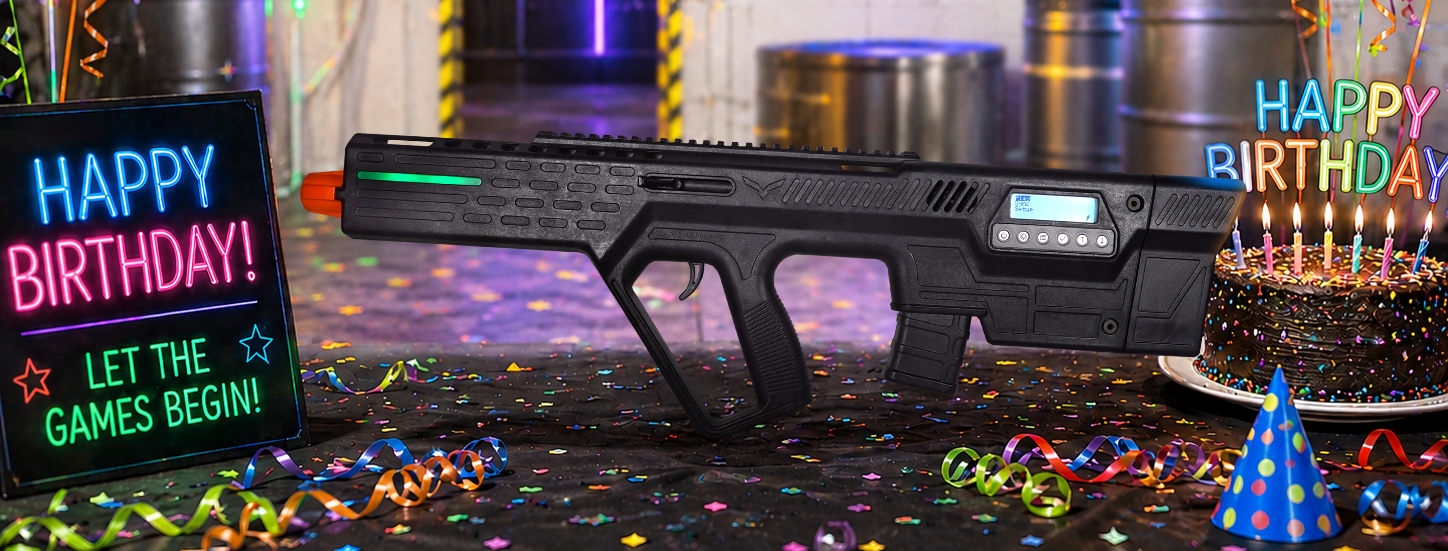
Why Birthday Parties Are Your Most Profitable Revenue Stream
Ask almost any successful family entertainment operator where their strongest margins come from. The answer is almost always the same: parties and group events.
A typical birthday package generates revenue from multiple sources simultaneously:
Revenue Source | Example Amount |
Party package (laser tag + room rental) | $300 |
Additional guests | $75 |
Food and drinks | $100 |
Arcade or add-on attractions | $50 |
Total event revenue | $525 |
Four similar parties every weekend equals more than $100,000 annually from birthday events alone, before public play, memberships, or corporate bookings are counted.
The Hidden Cost Most New Operators Ignore
One of the biggest mistakes new operators make is evaluating commercial laser tag equipment on purchase price alone. Durability, support quality, and downtime have a far greater impact on long-term profitability.
When equipment fails during a busy Saturday afternoon, the cost goes well beyond the repair bill:
- Lost game revenue ($300–$500+ per canceled session)
- Customer refunds and complaints
- Negative reviews that affect future bookings
- Staff time managing the disruption
- Reduced repeat visit rates
Investing an additional $10,000–$25,000 in a more reliable system may pay for itself many times over through reduced downtime and improved customer retention. That's the concept of total cost of ownership, what the equipment costs you over 5–7 years, not just on day one.
This is the core distinction between professional and consumer-grade laser tag systems. Professional equipment is engineered to withstand heavy throughput, maintain consistent performance, and be serviced quickly when something goes wrong. Consumer-grade systems are not. When evaluating laser tag systems for sale, the price tag reflects the hardware, the ROI reflects the reliability, support infrastructure, and software ecosystem behind it.
The Importance of Repeat Customers
Most attractions depend on constantly acquiring new customers. Laser tag performs best when customers come back regularly.
Your content goes here. Edit or remove this text inline or in the module Content settings. You can also style every aspect of this content in the module Design settings and even apply custom CSS to this text in the module Advanced settings.
Customer Type | Annual Visits | Spend per Visit | Annual Value |
One-time visitor | 1 | $25 | $25 |
Monthly member | 12 | $25 | $300 |
Bi-weekly player | 26 | $20 (member rate) | $520 |
Multiply that difference across 100 customers: one-time visitors generate $2,500 annually. Monthly members generate $30,000. That gap is where laser tag businesses either thrive or struggle.
Features that drive repeat visits:
- Player rankings and seasonal leaderboards
- Competitive leagues and team tournaments
- Membership programs with perks
- Updated game modes (iCOMBAT's iCE software adds new modes)
- Achievements, rewards, and progression systems
Common Mistakes That Reduce Laser Tag Profitability
Choosing Equipment Based on Price Alone
A lower-priced system may cut startup costs but create recurring losses through downtime, poor support, and customer churn. Evaluate total cost of ownership, not just the purchase price.
Underestimating Repeat Play
New operators often focus heavily on customer acquisition while overlooking retention. Memberships, leagues, player rankings, and updated game modes can double customer lifetime value without increasing marketing spend.
Building Too Much or Too Little Arena Space
Undersized arenas limit throughput and party capacity. Oversized arenas carry unnecessary occupancy costs. Design around your projected demand and revenue goals.
Ignoring Party and Group Revenue
Birthday parties, school groups, and corporate events are often the highest-margin revenue in the business. Facilities designed to accommodate groups consistently outperform those focused solely on just public play.
Selecting a System with Limited Software and Game Content
Today's players expect more than a single game mode. iCOMBAT's iCE software offers many game modes and allows for customization, player profiles, achievements, rankings, and reporting tools, giving operators the tools to keep customers engaged long after their first visit.
Why Your Laser Tag Manufacturer Has a Direct Impact on ROI
A laser tag system is more than hardware. The best commercial laser tag equipment combines reliable hardware, advanced software, ongoing game development, technical support, and operator training into a complete platform for running a profitable business.
Whether you're purchasing laser tag equipment for an indoor or outdoor arena, mobile laser tag equipment for events, or tactical laser tag equipment for an immersive experience, the manufacturer you choose directly influences customer retention, operational efficiency, and profitability.
The best manufacturers and suppliers help operators improve profitability by providing the following:
- Reliable commercial-grade equipment with uptime performance
- Software updates, new game modes, and player engagement tools
- Reporting and analytics to track revenue per session and customer retention
- Financing options to manage startup capital
- Technical support and operator training
- Business planning resources and custom business plans
Is Laser Tag a Good Investment?
For the right operator, yes, laser tag can be an excellent investment.
The industry benefits from broad age appeal, strong demand for group events, recurring revenue opportunities, and relatively low consumable costs compared to most other entertainment businesses.
Profitability is never guaranteed. The difference between a thriving laser tag business and a struggling one comes down to planning, execution, equipment reliability, and the ability to keep players engaged long after their first visit.
If you're evaluating the investment, focus on these factors rather than startup costs alone:
- What is the projected revenue per square foot at 50% utilization?
- What is the lifetime value of a customer if they return monthly?
- What does downtime cost per hour at peak pricing?
- What is the total cost of owning and operating a laser tag system?
- How much does the equipment manufacturer charge for support and parts over 5 years?
- What percentage of revenue comes from repeat customers vs. new acquisition?
Ready to Evaluate Your Laser Tag Business Opportunity?
iCOMBAT has helped operators across 80+ countries build a profitable laser tag businesses. From mobile setups to full tactical arenas, we'll build a custom business plan around your market, your budget, and your goals.
👉 Book a Discovery Call with Our Team
Speak with an expert to plan your concept, budget, and setup.
Planning Your Laser Tag Business?
👉 Download our FREE Laser Tag Financial Analysis Templates!
Understand exactly what it takes to start, budget, and profit from a laser tag business.
Frequently Asked Questions
Is laser tag a profitable business?
Yes. A well-managed laser tag business generates 20–45% profit margins depending on the model. Mobile operations tend to run higher margins (30–50%) due to lower overhead. Indoor arenas generate more gross revenue but carry higher fixed costs. The most successful operators drive profitability through repeat customers, birthday parties, corporate events, and membership programs.
How long does it take to get ROI on a laser tag business?
Mobile laser tag businesses typically recover their investment in 6–18 months. Traditional and BattleQuest arenas take 1–2 years. Tactical arenas take 2–3 years. Family entertainment centers average 2–4 years. These timelines improve significantly with strong marketing pre-launch, high repeat play rates, and reliable equipment that minimizes downtime.
How much does a laser tag business owner make?
Owner income ranges from $30,000–$90,000 annually for a mobile owner-operator to $120,000–$450,000+ for a mid-size tactical arena. Large FEC operators can earn $200,000–$500,000+. Income scales with reinvestment, operators who put profits back into equipment, marketing, and staff tend to see compounding growth by year 3–5.
Is mobile laser tag more profitable than an indoor arena?
Mobile laser tag often produce higher profit margins (20–60%) due to minimal overhead, no lease, no full-time staff, and no utility bills. Indoor arenas generate more gross revenue but have higher fixed costs that compress margins to 20–45%. The right choice depends on your available capital, market, and long-term goals.
What are typical laser tag profit margins?
Mobile laser tag: 20–60% margin. Traditional/BattleQuest arena: 20–40%. Tactical arena: 25–45%. Family entertainment center: 15–40%. Margins improve significantly with strong repeat play, membership programs, and equipment that stays operational during peak hours.
Does better laser tag equipment improve profitability?
In most cases, yes. Reliable equipment reduces downtime, each canceled session can cost $300–$500+, improves customer satisfaction, and supports repeat visits. Advanced software features such as player profiles, rankings, and seasonal game modes increase customer lifetime value beyond the first visit.
What is the biggest mistake new laser tag operators make?
Evaluating equipment on purchase price alone. A lower-cost system may save money upfront but become far more expensive through repairs, poor support, and customer churn caused by downtime. Successful operators evaluate total cost of ownership: equipment lifespan, support quality, parts availability, software capabilities, and long-term ROI.
How much does commercial laser tag equipment cost?
Commercial laser tag equipment typically ranges from $8,500 to $18,000 for a 12-player mobile system, $20,000 to $60,000 for a 20-player traditional/Battle Quest arena system, and $45,000 to $120,000 for a 30-player tactical arena system. When comparing options, evaluate not just the purchase price but software capabilities, game variety, support services, parts availability, and expected equipment lifespan.